
Design Validation and Coordination for Prefabricated Mechanical Systems
Project Overview
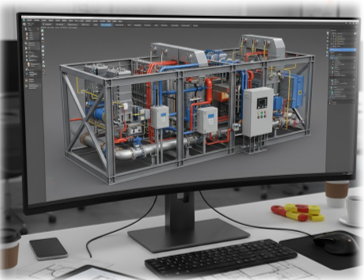
This case study presents a coordinated approach to validating prefabricated mechanical systems where multiple disciplines — mechanical, structural, and electrical — are integratedinto a single assembly model. The main objective was to ensure design accuracy, reduce site conflicts, and optimize prefabrication output.
In prefabricated mechanical systems, design coordination plays a crucial role in achieving assembly precision and minimizing installation issues. Initially, multiple teams were workingindependently, which created alignment and tolerance issues during production. The focus of this project was to implement an efficient validation workflow to ensure completemodel integrity before release to manufacturing.
Design Requirements
- Created a centralized 3D model to integrate mechanical, structural, and electrical layouts.
- Conducted multi-level model reviews to verify design intent and fitment sequence.
- Implemented a clash detection and clearance protocol for critical components
- Ensure dimensional accuracy and tolerance alignment across disciplines.
- Validate mounting and connection interfaces between frame, ducts, and electrical components.
- Ensure accessibility for maintenance and inspection.
- Maintain consistency between 3D model and fabrication drawings.
Key Tools
Operating System:Windows
Tools:
- MS Office
- SolidWorks
- Creo
- AutoCAD
Project Deliverables
- Coordinated and clash-free 3D model with validation report.
- Reviewed and approved fabrication drawings aligned with model output.
- Updated checklists for design validation workflow.
- Documented lessons learned and integration workflow for future projects.
Outcome / Results
- Reduced rework by 30% through early identification of fitment issues.
- Improved inter-department coordination, resulting in faster review cycles.
- Enhanced model accuracy, reducing field issues during assembly and testing.
Learning & Future Scope
- The validation process established a repeatable framework for future projects, ensuring each prefabricated modelundergoes standardized coordination checks.