
Design and Structural Development of Substation Isolator Switch
Project Overview
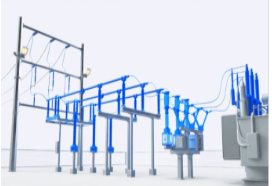
This project focuses on the design and structural development of a Substation Isolator Switch tailored specifically to meet client-defined technical and operational requirements. Using SOLIDWORKS, a high-precision 3D CAD and simulation tool, the isolator switch structure was designed, modeled, and validated to ensure mechanical reliability, operational accuracy, and compliance with international qualitystandards. The outcome is a fully engineered and simulation-verified model that ensures safe operation, ease of manufacturing, and compatibility with high-voltage substation environments.
Design Requirements
- To design a mechanically robust and electrically reliable isolator switch model.
- To ensure compliance with IEEE C37.30.1-2022 standard for high-voltage switches.
- To ensure design accuracy tolerance for critical mating components.
- To provide customers with fully detailed 2D manufacturing drawings and 3D assemblies for review andproduction.
- Design review: Internal peer-review confirmed conformity with IEEE C37.30.1-2022 and client specifications.
- BOM accuracy: Verified with standard hardware and material availability for local manufacturing.
Key Tools
Operating System:Windows
Tools:
- MS Office
- SolidWorks
- AutoCAD
Project Deliverables
- 3D CAD Assembly Model: Integrated compressor, heat exchangers, expansion valve, and fan modules. Verified
- clearances and service access using clash detection tools.
- Detailed Drawings: Isometric piping drawings showing pipe diameters, flow direction, insulation, and valve
- placements. Sheet metal flat patterns for enclosure fabrication.
- BOM & Documentation: Comprehensive Bill of Materials listing refrigerant components, sheet metal parts, and
- fasteners. Technical report summarizing design logic, testing results, and regulatory compliance (EN378 /ASHRAE 15).
Outcome / Results
- Reduced post-design rework due to strict quality verification.
- Enhanced visualization and presentation of products for client demonstrations.
- Enhanced visualization and presentation of products for client demonstrations.
Learning & Future Scope
- Learning electrical clearance, dielectric strength, and arc-quenching requirements for high-voltageapplications.
- Knowledge of advanced materials (aluminum, stainless steel, composite insulators) for strength,corrosion resistance, and electrical insulation.
- Designing isolators for higher voltage classes (up to 1200 kV) with compact footprints for urbansubstations.