
High-Efficiency Heat Pump System Design and Optimization
Project Overview
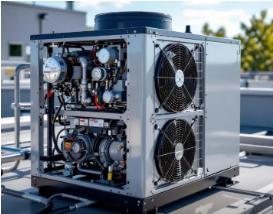
The project focused on the development and optimization of a high-efficiency air-to-water heat pump system for industrial HVAC applications.
The initiative aimed to reduce energy consumption and carbon footprint while maintaining heating and cooling performance across variable climate conditions.
The design involved refrigerant circuit optimization, compressor selection, heat exchanger redesign, and full 3D CAD integration to ensure system reliability, manufacturability, and regulatory compliance.
Design Requirements
- Mechanical Layout & Piping Design: Develop compact piping routes with minimal pressure drop. Designvibration-isolated mounts for compressor and fans.
- Sheet Metal and Structural Design: Create enclosure for optimal airflow and easy maintenance access. Includeinsulation, drain routing, and ventilation panels for safety. Updated 3D CAD models reflect componentintegration, dimensional accuracy, and tolerance alignment across disciplines.
- Electrical & Control Integration: Incorporate inverter-driven compressor control. Ensure interface compatibilitywith building management systems (BMS).
Key Tools
Operating System:Windows
Tools:
- SolidWorks
- AutoCAD
- Creo
- MS Office
Project Deliverables
- 3D CAD Assembly Model: Integrated compressor, heat exchangers, expansion valve, and fan modules. Verifiedclearances and service access using clash detection tools.
- Detailed Drawings: Isometric piping drawings showing pipe diameters, flow direction, insulation, and valveplacements. Sheet metal flat patterns for enclosure fabrication.
- BOM & Documentation: Comprehensive Bill of Materials listing refrigerant components, sheet metal parts, andfasteners.
Outcome / Results
- Achieved 30% higher energy efficiency compared to the baseline heat pump system.
- Reduced refrigerant charge by 20% without compromising performance.
- Enhanced maintenance accessibility and serviceability through optimized enclosure design.
- 3D model validation reduced design iteration time by 25%, improving project delivery schedule.
- The design met A2L refrigerant safety standards and ISO 5149 compliance for system safety.
Learning & Future Scope
- Developed a standardized model and validation workflow for future heat pump projects.
- The project established a reusable CAD and calculation library, reducing design cycle time for future variants.